
How to Mail an Eviction Notice (2025 Guide)
Important: Check Your State Laws First
Eviction procedures vary significantly by state and even by city. This guide provides general information, but you must follow your specific jurisdiction's requirements for:
- • Type of notice required (pay or quit, cure or quit, unconditional quit)
- • Required notice period (3 days, 7 days, 30 days, etc.)
- • Allowed service methods (mail, personal service, posting)
- • Specific form or language requirements
Quick Answer: Mailing Eviction Notices
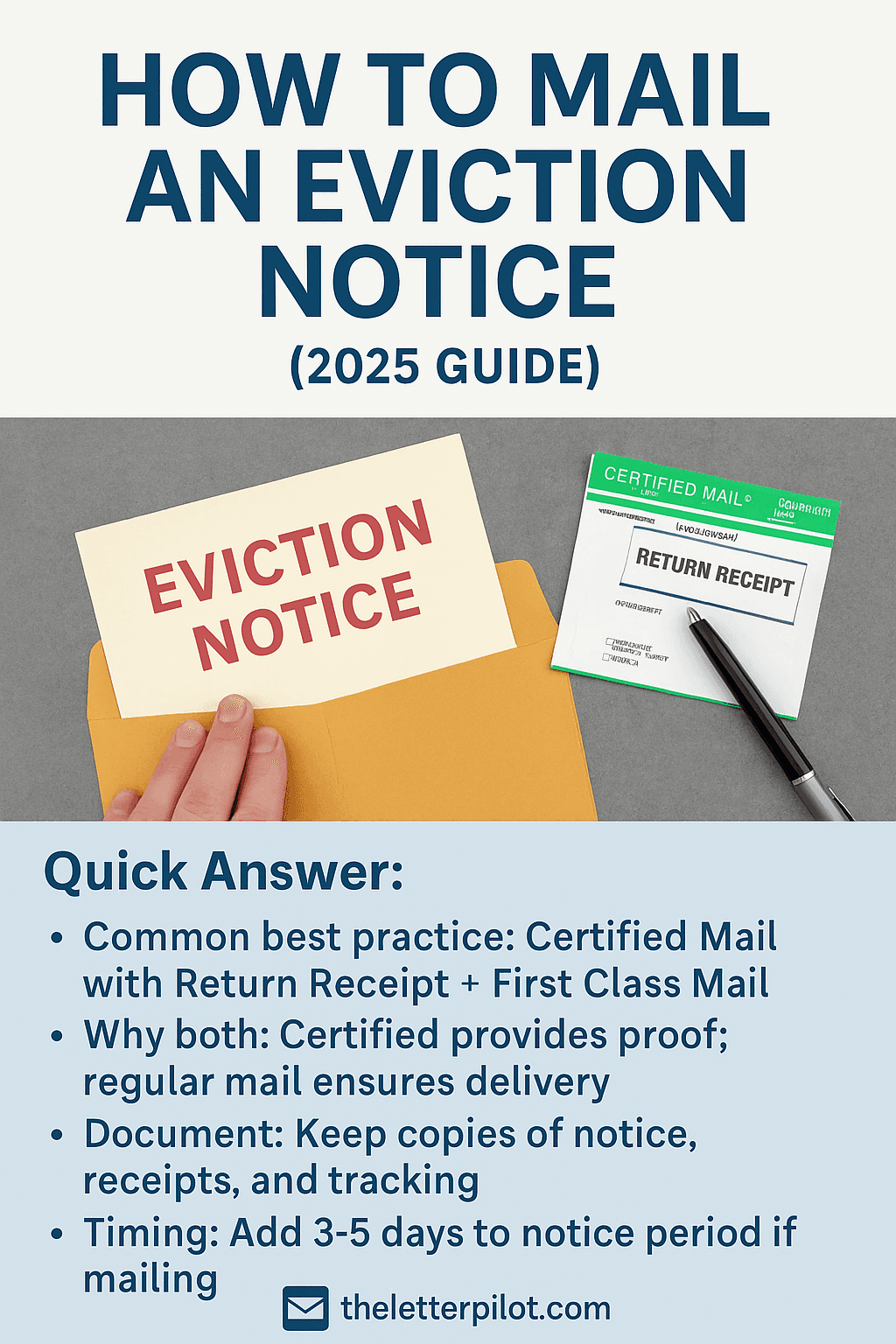
- Common best practice: Certified Mail with Return Receipt + First Class Mail (where allowed by your state's rules)
- Why both: Certified provides proof; regular mail ensures delivery if certified is refused
- Document: Keep copies of everything - notice, receipts, tracking, green card
- Timing: Add 3-5 days to notice period if mailing (check state law)
Properly serving an eviction notice is critical to the eviction process. If service is done incorrectly, your case can be dismissed in court, costing you time and money. This guide explains how to serve an eviction notice by mail, what documentation to keep, and common mistakes to avoid. For a primer on certified mail in general, see What Is Certified Mail?
You can also send mail online; we print, stamp, and hand your mail to USPS.
In This Guide
Types of Eviction Notices
Before mailing, ensure you are using the correct type of notice:
| Notice Type | When Used | Typical Period |
|---|---|---|
| Pay or Quit | Non-payment of rent | 3-14 days |
| Cure or Quit | Lease violations that can be fixed | 7-30 days |
| Unconditional Quit | Serious violations (must leave, no cure option) | 3-30 days |
| Notice to Terminate Tenancy | End of month-to-month lease | 30-60 days |
Service Methods by State (General Guidelines)
States have different requirements for how eviction notices must be served. Common methods include:
Personal Service (Hand Delivery)
Many states prefer or require personal service first. The notice is handed directly to the tenant. A witness or process server may be recommended.
Substituted Service
If tenant is unavailable, some states allow leaving the notice with another adult at the property, then mailing a copy.
Posting (Nail and Mail)
Post the notice on the property door and mail a copy. Usually only allowed after personal service fails.
Mail Service
Sending by mail only. Some states allow this; many require it as backup to another method. Certified mail is strongly recommended.
State-Specific Requirements
Always verify your state's exact requirements. Examples:
- California: Personal service first, then substituted service, then posting + mailing
- Texas: Personal service or mail or posting, landlord's choice in most cases
- New York: Personal service required; mail alone is not sufficient
- Florida: Personal service or posting + mail if tenant cannot be found
How to Send Eviction Notice by Certified Mail
Step 1: Prepare the Notice
- Use your state's required form or language
- Include tenant's full legal name(s)
- Include complete property address with unit number
- State the reason for eviction clearly
- Specify the exact deadline (date, not just "30 days")
- Make multiple copies: original for tenant, copies for your records
- Sign and date the notice
Step 2: Address the Envelope
- Address to each tenant on the lease (send separate certified letters if required)
- Use the rental property address as the mailing address
- Include your return address
Step 3: At the Post Office
- Request "Certified Mail with Return Receipt Requested"
- Complete PS Form 3800 (certified mail receipt)
- Complete PS Form 3811 (green card return receipt)
- Also send a copy via regular first-class mail (same day, same address)
- Get receipts for both mailings
Step 4: Document and Track
- Record the tracking numbers
- Track delivery online at USPS.com
- Save the green card when it returns
- Keep all receipts with your eviction file
Documentation to Keep
If you go to court, you will need to prove proper service. Keep:
- Copy of the notice: Exact copy of what you sent
- Certified mail receipt (PS Form 3800): Shows tracking number, date mailed, address
- Return receipt (green card): Shows date delivered and who signed
- First-class mail receipt: If you sent regular mail as backup
- Tracking printout: Screenshot or printout of USPS tracking showing delivery
- Returned letter: If the notice was refused or unclaimed, keep it sealed
- Proof of Mailing affidavit: Some courts require a signed statement of how you served the notice
Notice Period When Mailing
When you mail an eviction notice, the notice period typically starts when the tenant receives it, not when you mail it. Many states add extra days to account for mail delivery:
| If Notice Says | Add for Mailing | Effective Period |
|---|---|---|
| 3 days | +3-5 days (varies by state) | 6-8 days from mailing |
| 7 days | +3-5 days | 10-12 days from mailing |
| 30 days | +3-5 days | 33-35 days from mailing |
Check your state law for the exact number of days to add for mailed service. Some states specify this; others leave it to court interpretation.
If the Notice Is Refused or Unclaimed
Tenants sometimes refuse certified mail or let it go unclaimed. Here is what to do:
- Keep the returned letter sealed: Do not open it. The sealed, returned letter is evidence.
- The regular mail copy helps: This is why you send both - if certified is refused, regular mail may be delivered.
- Attempted service may count: In many states, a properly addressed certified letter that is refused or unclaimed may be treated as legally served, but rules vary by jurisdiction.
- Document the return: Save the tracking showing "Refused" or "Unclaimed" status.
- Consider alternate service: If required by your state, attempt posting on the door or personal service.
Common Mistakes to Avoid
- Wrong address: Mail to the rental property, not a different address, unless you know they have moved.
- Missing a tenant: If multiple people are on the lease, each adult tenant should receive a notice.
- Wrong notice type: Using a 30-day notice when a 3-day pay-or-quit is required, or vice versa.
- Wrong notice period: Not following state-mandated waiting periods.
- No proof of service: Sending regular mail only with no tracking or return receipt.
- Filing in court too early: Not waiting for the notice period to expire (including extra days for mail).
- Improper content: Missing required language or making threats that could be considered harassment.
Send Eviction Notices by Certified Mail Online
Skip the post office. Upload your eviction notice and we print and send it via USPS Certified Mail with Return Receipt. Same-day processing, full tracking, and documentation for court.
Send Certified Mail OnlineFAQs
Do I have to send an eviction notice by certified mail?
Requirements vary by state. Some states require certified mail, others allow regular mail, and many require personal service (hand delivery) first. Even when not required, certified mail provides proof of service that protects you in court. Check your state's landlord-tenant laws for specific requirements.
What if the tenant refuses to accept the certified mail eviction notice?
In many states, a refused or unclaimed certified letter may be treated as legally served, but rules vary by jurisdiction. Keep your certified mail receipt and the returned (unopened) letter as proof of attempted service. Some states may require you to also attempt personal service or posting on the door.
When does the eviction notice period start if sent by mail?
In most states, the notice period starts when the tenant receives the notice, not when you mail it. Many states add extra days (typically 3-5) to the notice period when service is by mail to account for delivery time. Check your state's specific rules.
Can I email an eviction notice instead of mailing it?
In most states, email alone is not sufficient for legal service of eviction notices. Physical mail or personal delivery is typically required for valid service. Email may be used as additional notice but should not be the only method.
Should I send the eviction notice to all tenants on the lease?
Yes. Each adult tenant named on the lease should receive a separate eviction notice. This ensures all parties are properly notified. Some landlords send individual certified letters to each tenant at the same property address.
What is the difference between an eviction notice and a notice to vacate?
A "notice to vacate" is often used interchangeably with eviction notice, but technically a notice to vacate may simply be notice that a tenancy is ending (like a 30-day notice for month-to-month), while an eviction notice demands the tenant leave due to a specific violation. See our notice to vacate guide for more details.
Related Guides
- How to Mail a Notice to Vacate
- How to Send a Demand Letter by Mail
- What is Certified Mail?
- How to Fill Out PS Form 3800
- How to Fill Out PS Form 3811 (Green Card)
- How to Track Certified Mail
Legal Disclaimer
This guide provides general information about mailing eviction notices and is not legal advice. Eviction laws vary significantly by state, city, and situation. Improper service can invalidate your eviction case. For specific legal questions about eviction procedures in your jurisdiction, consult with a licensed attorney or your local housing authority.
Tags: eviction notice, mail eviction notice, serve eviction notice by mail, certified mail eviction, landlord eviction, tenant eviction notice, eviction service, eviction notice certified mail