
How to Mail DMV Paperwork (2025): Title Transfers, Registration & License Renewals
Mail DMV Documents with Tracking
Protect your vehicle title and DMV documents with certified mail tracking—get delivery confirmation and proof you sent everything.
Send DMV Documents SecurelyNeed to know how to mail DMV paperwork? You're in the right place. DMV paperwork often involves valuable documents like vehicle titles, and losing a title in the mail can mean weeks of delays and duplicate title fees. This guide covers how to mail DMV documents safely, what paperwork you'll need, and how to protect yourself with tracking and proof of delivery.
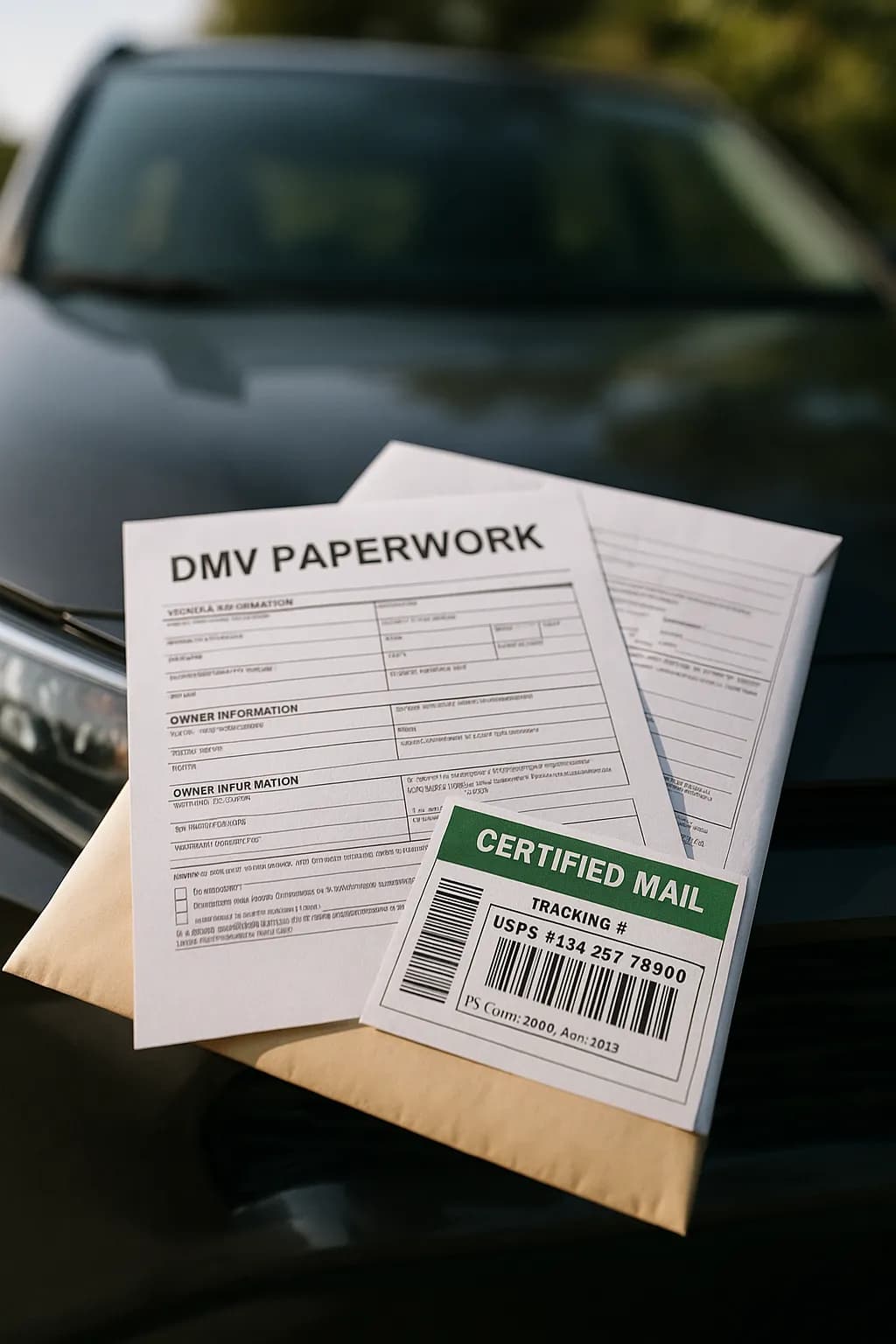
Important: DMV Requirements Vary by State
Every state has different:
- • Forms and documentation requirements
- • Mailing addresses (often different for each transaction type)
- • Fees and payment methods accepted
- • Processing times
Always check your state's DMV website for current requirements before mailing.
Note: Some states use different names for their motor vehicle agency—BMV (Ohio, Indiana), RMV (Massachusetts), MVD (Arizona, New Mexico), or Secretary of State (Illinois, Michigan). The same mailing tips apply regardless of what your state calls it.
If you need to mail a physical letter without visiting the post office, you can also send letter online.
Table of Contents
Common DMV Mail Transactions
Many DMV transactions can be completed by mail, saving you a trip to the DMV office:
Usually Eligible for Mail
- • Vehicle title transfers
- • Registration renewals
- • License renewals (if eligible)
- • Duplicate title requests
- • Lien release processing
- • Address changes
- • Personalized plate orders
Usually Requires In-Person
- • First-time license applications
- • Real ID upgrades
- • Commercial driver's license (CDL)
- • VIN inspections
- • Written/driving tests
- • Some out-of-state transfers
Mailing Title Transfers
Title transfers are one of the most common—and highest-stakes—DMV mail transactions. A lost title can take weeks to replace.
Typical Title Transfer Requirements
- • Original signed title (properly filled out)
- • Title application (state-specific form)
- • Bill of sale (some states)
- • Odometer disclosure (for vehicles under 10 years old)
- • Smog/emissions certificate (some states)
- • Payment for title and registration fees
- • Lien release (if applicable)
Title Transfer Tips
- • Make copies of the signed title before mailing
- • Take photos of all documents for your records
- • Use certified mail with return receipt
- • Never mail a blank signed title
- • Check signatures match exactly
- • Verify lien release is included if needed
Why Tracking Is Essential for Titles
Vehicle titles are legal documents that prove ownership. If your title is lost in the mail:
- • You'll need to apply for a duplicate title (fees + waiting)
- • The buyer may not be able to register the vehicle
- • Both parties may need to sign new documents
- • The process can take 4-8 weeks to resolve
Mailing Vehicle Registration
Registration renewals are often the easiest DMV transactions to complete by mail.
Registration Renewal by Mail
- • Renewal notice from DMV (if you received one)
- • Payment for registration fees
- • Smog certificate (if your state requires it)
- • Insurance verification (some states)
- • Completed renewal form (if no renewal notice)
Online vs. Mail Registration
Many states now offer online registration renewal, which is faster than mail. Check your state DMV website first—you may be able to renew instantly online and skip the mail entirely.
Mailing License Renewals
Not all license renewals can be done by mail—eligibility depends on your state and license status.
Mail Renewal Eligibility (Varies by State)
- • Your current license must be valid (not expired too long)
- • Your photo and information are up to date
- • You don't need a new photo taken
- • You're not upgrading to Real ID
- • You meet age and driving record requirements
License Renewal Documents
- • Renewal application (state-specific form)
- • Payment for renewal fee
- • Vision test results (some states, if required)
- • Medical certification (for certain license types)
How to Mail DMV Documents Safely
Step 1: Gather All Documents
- • Check state DMV website for exact requirements
- • Complete all forms fully and accurately
- • Sign where required (use black ink)
- • Make copies of everything before mailing
Step 2: Prepare Payment
- • Check accepted payment methods (check, money order, card)
- • Make check payable to your state DMV (exact name varies)
- • Write your license/plate number on the check memo
- • Don't send cash
Step 3: Use Correct Address
- • Different transactions may have different addresses
- • Verify address on your state DMV website
- • Include your return address on the envelope
Step 4: Choose Trackable Mailing
- • Certified Mail with Return Receipt - best for titles
- • Priority Mail - good for most documents
- • Regular First-Class - only for low-value items
- • Keep tracking number until transaction is complete (learn how to track certified mail)
Recommended: Certified Mail for Titles
For any document involving a vehicle title, use USPS Certified Mail with Return Receipt. The small extra cost ($7-8) is worth it for documents that could take months to replace if lost. Need proof you mailed something? Certified mail provides that documentation automatically.
Finding Your DMV Mailing Address
Every state has different DMV addresses, and each transaction type may have its own address.
How to Find the Correct Address
- Go to your state's official DMV website
- Search for your specific transaction type
- Look for "mail-in" or "by mail" instructions
- The address will be specific to that transaction
- Double-check the address before mailing
Common State DMV Websites
- • California: dmv.ca.gov
- • Texas: txdmv.gov
- • Florida: flhsmv.gov
- • New York: dmv.ny.gov
- • Pennsylvania: dmv.pa.gov
- • Illinois: ilsos.gov
Search "[Your State] DMV" for your state's official site.
Frequently Asked Questions
Should I mail DMV documents by certified mail?
Yes, using certified mail or another trackable service is strongly recommended for DMV documents. Vehicle titles are valuable and difficult to replace if lost. Tracking provides proof of delivery and protection if your documents are lost in transit.
Where do I mail DMV paperwork?
The DMV mailing address varies by state and document type. Check your state's DMV website for the correct address. Many states have different addresses for title transfers, registration renewals, and license-related documents.
Can I mail my vehicle title to the DMV?
Yes, most states allow you to mail vehicle titles for transfers, duplicate title requests, and lien releases. Always send titles via certified mail or another trackable service because they're difficult and time-consuming to replace if lost.
How long does DMV mail processing take?
DMV mail processing times vary by state and transaction type. Generally, expect 2-6 weeks for most transactions. Title transfers may take longer. Check your state DMV website for current processing times.
What if my DMV documents get lost in the mail?
If you used trackable mail, contact the carrier first to locate your package. If documents are confirmed lost, contact your DMV to start the replacement process. For titles, you'll need to apply for a duplicate. This is why tracking is essential.
Can I track my DMV application?
You can track your outgoing mail using USPS or carrier tracking. Some states offer online status checking for DMV applications. Contact your state DMV for status inquiries if online tracking isn't available.
Mail Your DMV Documents with Confidence
Send your title transfers and DMV paperwork via Certified Mail with tracking—next-business-day mailing for orders by 8 PM ET.
Send DMV Documents NowRelated Government Mailing Guides
Last updated: • DMV mailing guide
Tags: mail DMV paperwork, DMV mailing address, mail title transfer, DMV registration by mail, mail documents to DMV